POLICY OPTIONS FOR STUDENT BICYCLE & E-MOBILITY DEVICES
An Action Plan for School Boards and Administrators
EXECUTIVE SUMMARY
Schools face a rapid increase in the number and variety of bicycles and electric mobility devices used by students to travel to and from school. While these devices can expand transportation options and encourage active transportation, they also present new safety and administrative challenges.
Most concerning, many schools have experienced increasing use of electric motorcycle-style devices (“e-motos”) that do not qualify as legal e-bikes under California law but often resemble them. And our ER doctors are reporting increases in motorcycle-type injuries suffered by our youth riding electric devices.
School districts have responded in different ways. Some permit only conventional bicycles, others allow pedal-assist e-bikes but prohibit throttle-powered devices, while others permit all legal e-bikes. Each approach reflects a different balance among student safety, active transportation, and ease of enforcement.
This guide presents three model policies designed to help school districts select the approach that best fits their community.
The three, ready-to-adopt policy models differ only in the types of devices permitted on school property. Each model:
· encourages safe transportation to school;
· prohibits illegal e-motos and other non-compliant electric vehicles;
· relies on California statutory definitions; and
· provides complete policy language that districts may adopt or modify.
KEY TAKEAWAYS FOR SCHOOL BOARDS
• Every district should adopt a clear, written policy governing bicycles and electric mobility devices.
• All three policy models prohibit e-motos and other illegal electric motorcycle-style devices. Under state law, these devices are not street legal. A school district faces potential liability for allowing students to use them.
• All three policy models also prohibit electric scooters for students without driver’s licenses or permits, consistent with California law.
• The key policy questions are how to deal with the otherwise legal pedal-assist e-bikes (Classes 1 and 3) and throttle-assist e-bikes (Class 2).
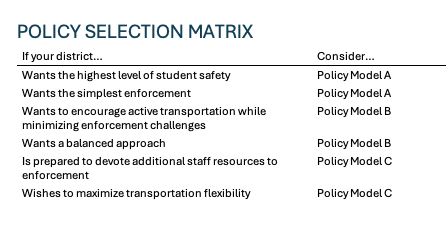
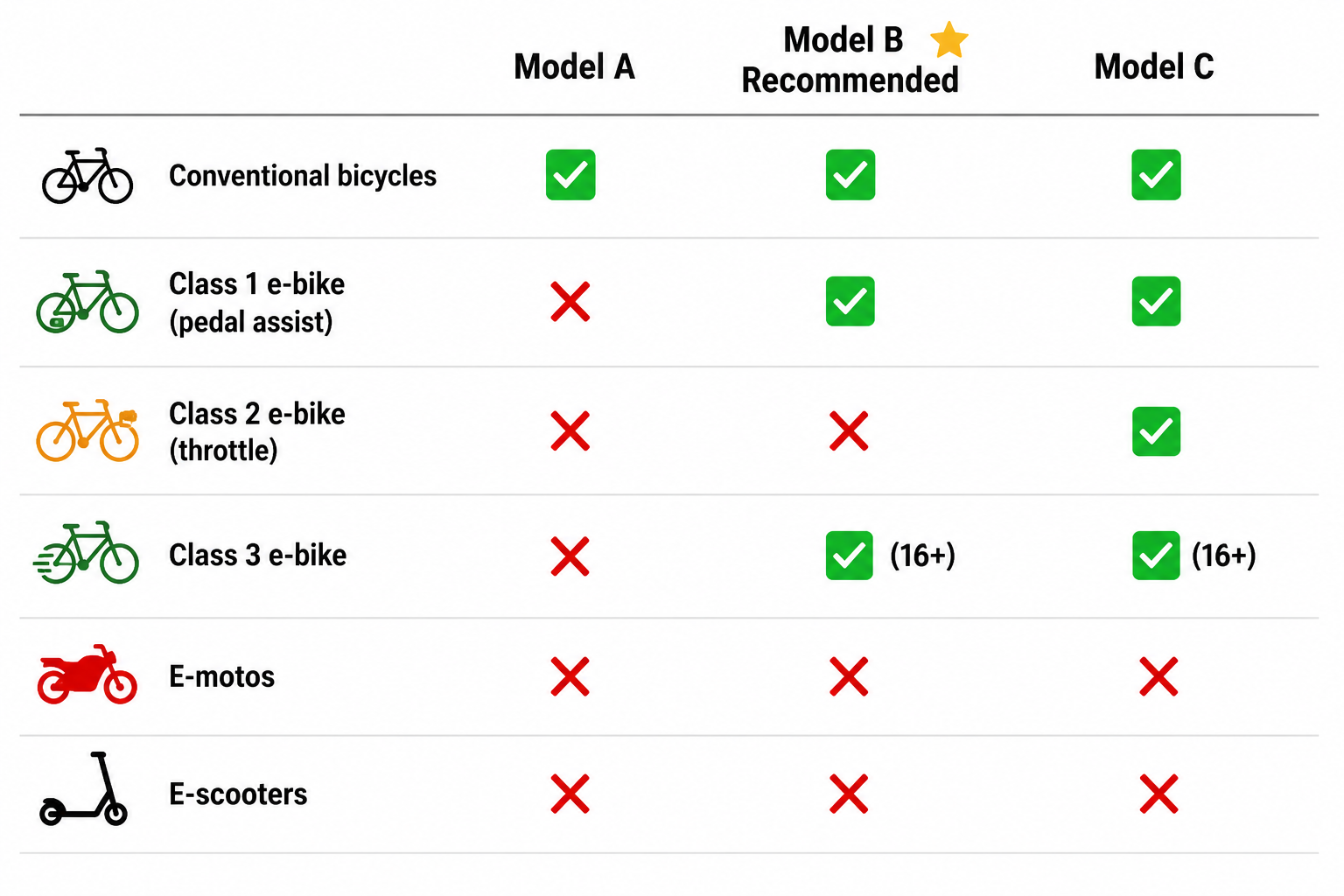
• Policy Model A prohibits all e-bikes, whether pedal-assist or throttle. It provides the highest level of student safety and the simplest enforcement.
• Policy Model B allows pedal-assist e-bikes (Class 1 and, for riders 16 or older, Class 3) but not throttle-activated ones (Class 2). It provides the best overall balance between student safety, active transportation, and administrative practicality.
• Policy Model C allows both types of e-bikes: pedal-assist e-bikes (Class 1 and, for riders 16 or older, Class 3) and throttle e-bikes (Class 2). It provides the greatest transportation flexibility but requires school personnel to distinguish legal Class 2 e-bikes from illegal e-motos and other motorcycle-style electric vehicles.
• Districts should inventory the two-wheelers parked on campuses and determine how many are Class 1-3 e-bikes and how many are e-motos. In selecting a policy, Districts should consider the importance of safety, student age, community conditions, staffing resources, and local transportation goals.
BOARD DECISION GUIDE
To select a policy model, consider the following questions:
· What level of student safety does the Board wish to prioritize?
· How many legitimate Class 2 e-bikes are present? At most schools, most if not all throttle devices exceed 20 mph and thus are not e-bikes.
· How much staff time can reasonably be devoted to enforcement?
· Are school personnel able to distinguish legal Class 2 e-bikes from illegal e-motos?
· What transportation challenges exist within the district?
· Which policy is most likely to be understood and consistently enforced?
The answers to these questions will help determine which policy model best aligns with the district’s priorities.
Model Policy A
Conventional Bicycle Campus
1. Purpose
The District encourages students to walk and ride conventional bicycles as healthy, sustainable forms of transportation while recognizing that electric mobility devices present different operational characteristics and safety risks. This policy is intended to balance those interests.
2. Findings
· School campuses are congested environments with dense pedestrian and vehicular traffic, and students on two-wheelers of various descriptions.
· While electric devices may provide more mobility, they also can be more dangerous given their speed, weight, acceleration and other factors.
· Under state law, throttle devices capable of speeds above 20 mph ('e-motos') are not considered e-bikes and require a driver's license, DMV registration, insurance and safety equipment.
· Published reports show that 80–90% of electric devices at schools are e-motos.
· Staff generally cannot determine compliance through casual observation.
· Recent medical studies report a concerning escalation of serious injuries from e-bike and e-moto collisions.
· Under state law, electric scooters require a driver's license or instructional permit.
· A bright-line rule improves compliance and consistency.
· A conventional-bicycle policy is the simplest to administer because it avoids disputes over vehicle classification, speed capability, or modification.
· This policy maximizes student safety, simplifies enforcement, eliminates the need for school staff to distinguish among multiple classes of electric mobility devices, and promotes a predictable campus environment centered on conventional bicycling.
3. Definitions
Conventional bicycle means a bicycle propelled solely by human power. Electric bicycles, e-scooters, electric motorcycles (e-motos), and other motorized devices are not conventional bicycles regardless of the presence of pedals.
4. Permitted Devices
Only conventional human-powered bicycles may be brought onto or operated on school property, except for mobility devices required by law as disability accommodations.
5. Prohibited Devices
Class 1, Class 2, and Class 3 electric bicycles; electric scooters; electric motorcycles/e-motos; and any other electrically powered personal mobility device.
6. Student Responsibilities
Students shall obey all traffic laws, wear helmets where required by law, ride at safe speeds, dismount where directed, and park only in designated bicycle parking areas.
7. Inspection Authority
When reasonably necessary to determine compliance, school administrators may inspect a device's manufacturer labeling and physical characteristics.
8. Enforcement
Prohibited devices may be denied entry, locked up pending notification of parents or guardians and retrieval by them, and removed from campus. Repeated violations will be reported to local law enforcement as may be appropriate. Attempts to evade this policy by parking off-campus will be reported to local law enforcement.
9. Parent Notification
The District will notify families at least annually of this policy.
Model Policy B
Limited E-Bike Campus.
1. Purpose
The District encourages students to walk and ride conventional bicycles and lower-speed, pedal-assist electric bicycles as healthy, sustainable forms of transportation while recognizing that throttle-activated electric mobility devices present different operational characteristics and safety risks. This policy is intended to balance those interests in a way that can be enforcement with a minimum of staff resources.
2. Findings
· School campuses are congested environments with dense pedestrian and vehicular traffic, and students on two-wheelers of various descriptions.
· While electric devices may provide more mobility, they also can be more dangerous given their speed, weight, acceleration and other factors.
· Under state law, throttle devices capable of speeds above 20 mph ('e-motos') are not considered e-bikes and require a driver's license, DMV registration, insurance and safety equipment.
· Published reports show that 80–90% of electric devices at schools are e-motos.
· Under state law, riders of Class 3 e-bikes must be at least 16 years of age.
· Staff generally cannot determine compliance with the e-bike classification system through casual observation. Manufacturer labels are known to be unreliable.
· Recent medical studies report a concerning escalation of serious injuries from e-bike and e-moto collisions.
· Under state law, electric scooters require a driver's license or instructional permit.
· A bright-line rule improves compliance and consistency.
· Permitting only pedal-assist electric bicycles while prohibiting higher-risk throttle devices balances transportation access with campus safety.
· Clear standards reduce enforcement disputes and promote a predictable campus environment.
3. Definitions
Class 1, Class 2, and Class 3 electric bicycles have the meanings provided by applicable state law. Electric motorcycles (e-motos) are not e-bikes regardless of the presence of pedals.
4. Permitted Devices
Conventional bicycles, Class 1 e-bikes (pedal assist) and, for students at least 16 years of age, Class 3 e-bikes (pedal assist) are permitted. Mobility devices required by law as disability accommodations are also permitted.
5. Prohibited Devices
Electric scooters; Class 2 e-bikes (throttle); electric motorcycles/e-motos; and any other electrically powered personal mobility device not expressly permitted by this policy.
6. Student Responsibilities
Students shall obey all traffic laws, wear helmets where required by law, ride at safe speeds, dismount where directed, and park only in designated bicycle parking areas.
7. Inspection Authority
When reasonably necessary to determine compliance, school administrators may inspect a device's manufacturer labeling and physical characteristics.
8. Enforcement
Prohibited devices may be denied entry, locked up pending notification of parents or guardians and retrieval by them, and removed from campus. Repeated violations may be reported to local law enforcement. Attempts to evade this policy by parking prohibited devices off-campus may also be referred to local law enforcement where appropriate.
9. Parent Notification
The District will notify families at least annually of this policy.
Model Policy C
Comprehensive E-Bike Campus
1. Purpose
The District encourages students to walk and ride conventional bicycles and lawful electric bicycles as healthy, sustainable forms of transportation. The policy bans e-motos that are not street legal under state law and requires staff to learn how to tell the difference between Class 2 e-bikes (which this policy allows) and e-motos (which consistent with state law this policy disallows).
2. Findings
· School campuses are congested environments with dense pedestrian and vehicular traffic, and students on two-wheelers of various descriptions.
· While electric devices may provide more mobility, they also can be more dangerous given their speed, weight, acceleration and other factors.
· Under state law, throttle devices capable of speeds above 20 mph ('e-motos') are not considered e-bikes and require a driver's license, DMV registration, insurance and safety equipment.
· Published reports show that 80–90% of electric devices at schools are e-motos.
· Staff generally cannot determine compliance through casual observation.
· Recent medical studies report a concerning escalation of serious injuries from e-bike and e-moto collisions.
· Nonetheless, despite the difficulty of distinguishing between types of throttle devices, the District seeks to protect the ability to ride Class 2 e-bikes.
3. Definitions
Conventional bicycles and Class 1, Class 2, and Class 3 electric bicycles have the meanings provided by applicable state law. Electric motorcycles (e-motos), electric scooters, and other motorized devices that do not meet the statutory definition of an electric bicycle are not e-bikes regardless of the presence of pedals.
4. Permitted Devices
Conventional bicycles and Class 1 (pedal assist), Class 2 (throttle), and Class 3 (pedal assist) electric bicycles are permitted, subject to applicable state law. Mobility devices required by law as disability accommodations are also permitted.
5. Prohibited Devices
Electric scooters; electric motorcycles/e-motos; and any other electrically powered personal mobility device that is not an electric bicycle under applicable state law.
6. Student Responsibilities
Students shall obey all traffic laws, wear helmets where required by law, ride at safe speeds, dismount where directed, and park only in designated bicycle parking areas.
7. Inspection Authority
When reasonably necessary to determine compliance, school administrators may inspect a device's manufacturer labeling and physical characteristics.
8. Enforcement
Prohibited devices may be denied entry, secured pending notification of parents or guardians and retrieval by them, and removed from campus. Repeated violations may be reported to local law enforcement as appropriate. Attempts to evade this policy by parking prohibited devices off-campus may also be reported to local law enforcement.
9. Parent Notification
The District will notify families at least annually of this policy.